

How to design the identity for an AI climate agentic platform - CEEW's CRAVIS.
- Upasana S
- 1 day ago
- 2 min read


Climate data is abundant, but clarity is not.
Organizations today have access to vast amounts of environmental information, yet transforming that information into meaningful action remains a challenge. CEEW's Cravis is build to bridge this gap through AI-powered climate intelligence, helping organizations track, interpret, and respond to climate-related data with confidence.
Our goal was to develop an identity that positioned CRAVIS not as a climate platform, but as the intelligence layer that makes climate information actionable.

The Design Challenge
The climate-tech landscape is saturated with predictable visual cues- leaves, globes, gradients, and environmental symbolism. While these elements communicate sustainability, they often fail to capture the sophistication of the technology behind the solution.
Cravis required a visual identity that could stand apart from this landscape. The identity needed to express intelligence, precision, structure, and trust while communicating the platform's ability to transform complex information into clear direction.
Design Approach

Instead of visualizing climate itself, we chose to visualize the process of understanding it.
Our exploration shifted from environmental imagery toward systems thinking, data structures, and computational logic. We looked at how information is organized, how patterns emerge from interconnected datasets, and how intelligence is created through relationships between individual pieces of information.
This shift became the foundation for the entire identity system.
The Big Idea
Intelligence Emerges Through Connection
Climate data rarely exists in isolation. Its value emerges when multiple variables connect to reveal patterns, risks, and opportunities.
This observation led us to the central idea behind the identity: a data construct.

Keywords:
Just as Cravis gathers fragmented climate signals and transforms them into actionable insights, the visual identity is built on the idea that meaningful intelligence emerges when individual units connect to form a larger system.
The concept allowed us to move away from conventional sustainability aesthetics and toward a visual language rooted in structure, logic, and intelligence.
Visual Explorations
The exploration began with studying data architectures, modular systems, network structures, and computational frameworks. Early directions investigated grids, nodes, pathways, and interconnected systems as visual representations of climate intelligence.
Through multiple rounds of refinement, the focus shifted toward creating a more distinctive and ownable expression of the concept. Rather than designing a separate
symbol and wordmark, we explored how a modular form could become an integral
part of the logo itself.

The process was ultimately about finding the balance between complexity and clarity, the same challenge Cravis solves through its technology.
THE FINAL LOGO
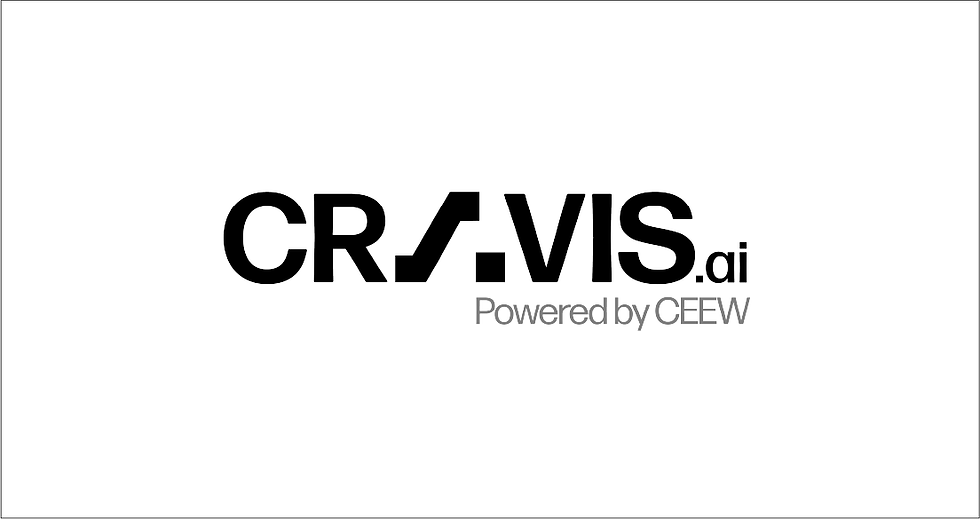


The form represents a building block within a larger system, a visual metaphor for how individual pieces of information come together to generate meaningful insight. Integrated directly into the logo, it reinforces the idea that intelligence is not created from a single source but through the connection and organization of many.
The result is an identity that feels precise, intelligent, and scalable while remaining distinct within the climate-tech space.


Launch of CRAVIS by honourable Minister of Commerce and Industry of India, Mr Piyush Goyal. New Delhi, April 2026.


Comments